


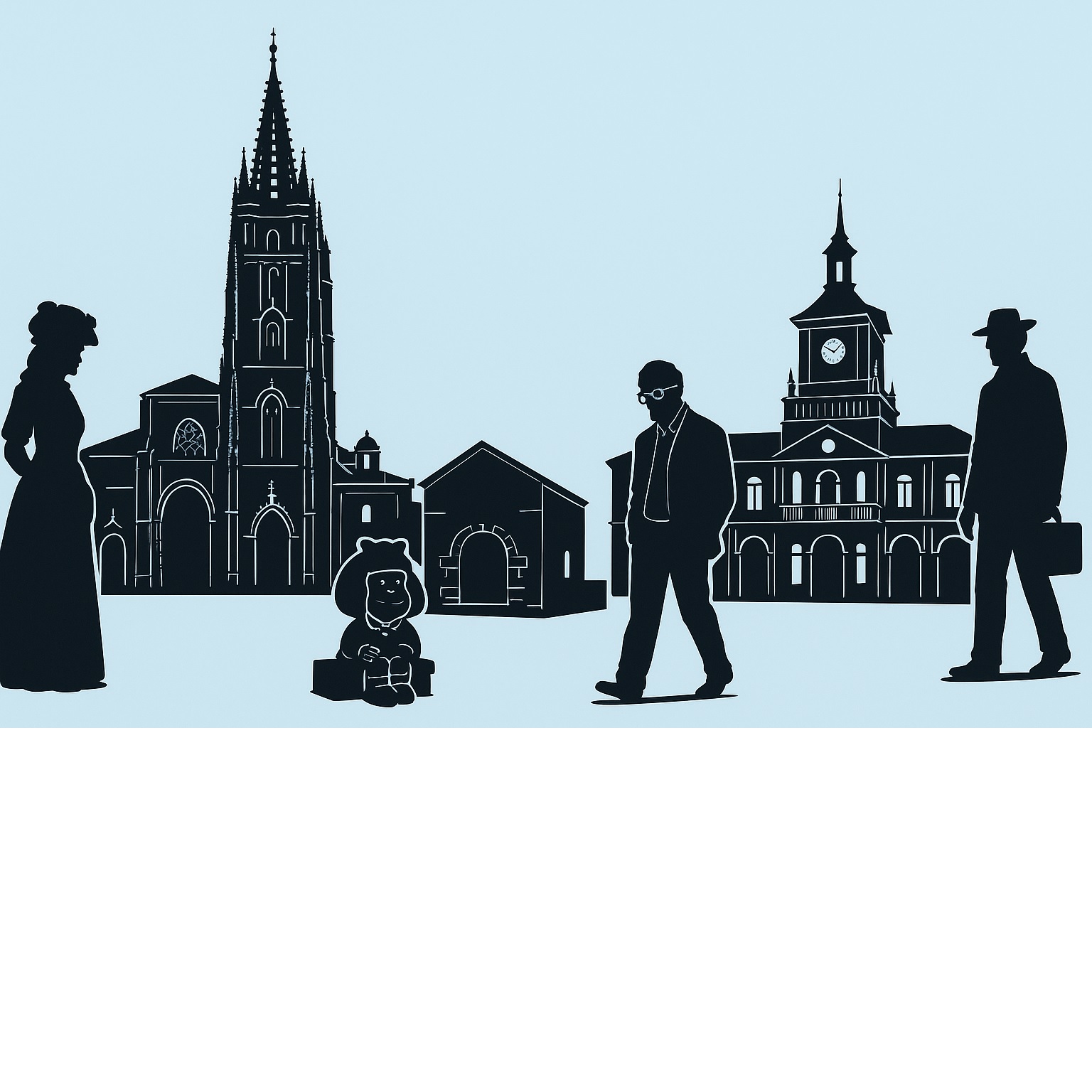
The origins of Oviedo
Oviedo's traditional origins date back to the 8th century. Medieval sources link the birth of the settlement to the monks Maximus and Fromestanus and to the foundation of a monastic establishment dedicated to Saint Vincent. That monastery was built in a place that, over time, would become the centre of a city of great political importance.

King Fruela I is also associated with Oviedo's earliest period. During his reign, a basilica dedicated to San Salvador and other religious buildings are believed to have been erected. However, the city's decisive development came a few decades later under Alfonso II.
From monastery to royal capital
Within a few decades, the small early medieval settlement came to play a central role in the Asturian monarchy. This transformation helps explain the exceptional concentration of Pre-Romanesque heritage preserved in Oviedo and its surroundings.
Alfonso II and the royal seat
The reign of Alfonso II the Chaste (791–842) was one of the decisive periods in Oviedo's history. The monarch established his court in Oviedo and created a true regia sedes, providing it with palaces, churches and buildings associated with royal and religious power.
Some of the most important surviving monuments of Pre-Romanesque Oviedo belong or are linked to this period, including San Julián de los Prados, San Tirso el Real, la Holy Chamber y la Foncalada. The city thus acquired a political and monumental importance far greater than that of the original settlement.
During the reign of Alfonso II, the tomb attributed to the Apostle Saint James was also discovered in Galicia. The Asturian monarch travelled to the site and ordered a church to be built there. Tradition regards that journey as the origin of the Primitive Way (Camino Primitivo), which starts in Oviedo and is considered the oldest route to Santiago.
The splendour of Pre-Romanesque art
Alfonso II's successors continued to enrich the royal surroundings. During the reign of Ramiro I, two remarkable buildings were erected on Mount Naranco: Santa María del Naranco y San Miguel de Lillo, two of the best-known works of Asturian Pre-Romanesque art.
Under Alfonso III, the Asturian monarchy entered a new period of expansion. The Victory Cross, dating from this period, eventually became one of the great symbols of Asturias. In 910, after the death of Alfonso III, the political centre of the monarchy shifted towards León and Oviedo ceased to be the royal court.
Medieval Oviedo: Cathedral, relics and pilgrims
Losing its status as a royal seat did not mean that Oviedo lost its importance. The city retained considerable religious prestige thanks to San Salvador and, especially, the relics kept in the Holy Chamber.
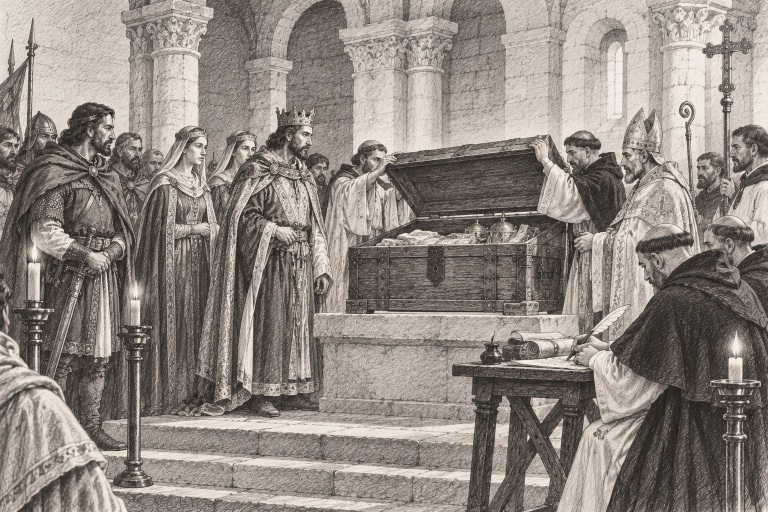
The solemn opening of the Holy Ark in 1075, in the presence of King Alfonso VI, strengthened the fame of the Oviedo sanctuary. Devotion to its relics —including the Holy Shroud— made Oviedo a destination for pilgrims and a stop closely connected with the routes to Santiago de Compostela.
During the Middle Ages, the urban layout became established around the episcopal precinct, the monasteries and the streets connecting the city gates. Institutions such as the Monastery of San Vicente y el Monastery of San Pelayo played a prominent role in religious and cultural life.
At the end of the 13th century, the great Gothic transformation of the cathedral complex began. The works continued for centuries and shaped much of today's Cathedral of San Salvador, whose tower would become one of Oviedo’s most recognisable landmarks.
The fire of 1521 and the Early Modern city
One of the events that most profoundly changed Oviedo's appearance was the great fire of 1521. The blaze destroyed or damaged much of the town, whose buildings made extensive use of timber. The subsequent reconstruction altered the appearance of many streets in the historic centre.
During the 16th and 17th centuries, new civic and religious buildings were added to the city. Spaces that are now an essential part of the old town took shape during this period, while palaces associated with Asturian noble families were built or remodelled.
A major milestone was the creation of the University of Oviedo, promoted by Archbishop Fernando de Valdés Salas and opened for teaching at the beginning of the 17th century. The University became one of the key institutions in the city's cultural life.
In the 18th century, the Enlightenment also left an important mark. Oviedo became a notable intellectual centre associated with figures such as Benito Jerónimo Feijoo, who carried out much of his work at the Monastery of San Vicente.
The 19th century: expansion and urban transformation
The 19th century progressively transformed the scale and appearance of Oviedo. The removal of sections of the old walls, the opening of new streets and growth beyond the historic centre allowed the city to expand.
The arrival of the railway encouraged the development of a new urban axis between the North Railway Station and the city centre. Calle Uría gradually became one of Oviedo's main thoroughfares, while new residential, commercial and administrative buildings appeared.
Asturias' economic growth, linked to mining, industry and transport, directly affected Oviedo as an administrative and service capital. Buildings that still define the urban landscape were constructed in this context, including the Campoamor Theatre.
Late-19th-century Oviedo was also immortalised in literature in La Regenta by Leopoldo Alas “Clarín”, in which Oviedo is transformed into the fictional city of Vetusta. The novel is one of the best-known literary portrayals of Oviedo's urban society of the period.
Oviedo in the 20th century
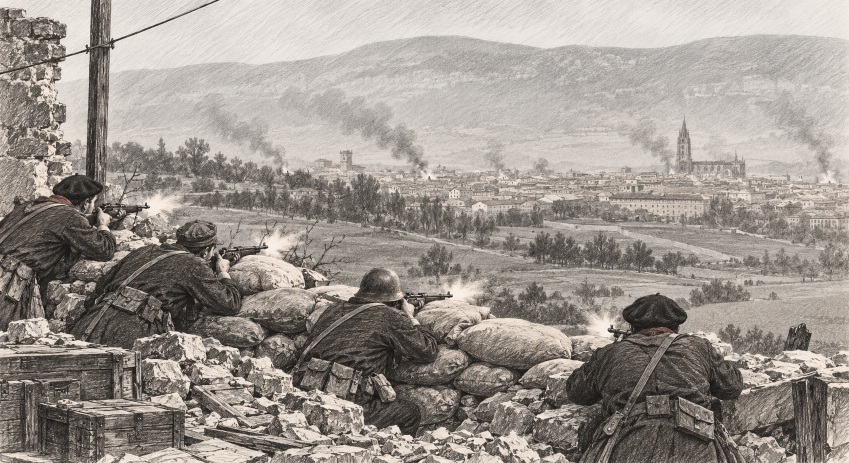
The 20th century was marked by rapid urban expansion, but also by some of the most difficult episodes in the city's modern history. Oviedo was one of the main centres of the Asturian Revolution of October 1934. The fighting and repression caused numerous casualties and serious material damage; several buildings and historic collections were destroyed.
Two years later, during the Spanish Civil War (1936–1939), Oviedo once again became the scene of intense fighting. The city remained under siege for months and suffered extensive destruction. The post-war period brought a long reconstruction process that once again altered part of its urban landscape.
From the mid-20th century onwards, Oviedo expanded into new neighbourhoods and greatly increased its services and infrastructure. Asturias' economic transformation and the growth of the service sector strengthened its role as the administrative, university, commercial and cultural capital of the Principality.
The contemporary city
In recent decades, the restoration of the historic centre, the pedestrianisation of many streets and renewed appreciation of the city's heritage have strengthened the connection between present-day Oviedo and its past. New facilities and examples of contemporary architecture have joined its medieval and Pre-Romanesque monuments, including the Príncipe Felipe Auditorium y el Exhibition and Conference Centre.
Today, within a relatively compact area, Oviedo preserves traces of all these periods: the former seat of the Asturian kings, the episcopal and pilgrimage city, Clarín's Vetusta, the bourgeois capital of the 19th and 20th centuries, and the contemporary city.
The history of Oviedo through its monuments
These places offer a tangible journey through some of the main periods in the city’s history: